Pushkar Ghats Through The Lens
May 21, 2009 by Gennaro
Filed under Destinations, Featured, Photography
Pushkar is located on the shore of Pushkar Lake in Rajasthan, India. It is an important pilgrimage site for followers of the Hindu faith. The lake has countless ghats, which are a series of steps that lead down to its sacred waters. The city is filled with devout Hindus who descend into the waters of the lake for a spiritual cleansing along with travelers who are observing the cultural happenings.
Follow this photographic journey around the ghats of Pushkar:
Holy Cow + Preparing To Bathe © Gennaro Salamone
Sacred cows are seen throughout India including Pushkar. Whether it’s a rural area or walking down the streets of a major city, cows are a permanent part of the landscape. Revered by followers of the Hindu faith, the animals are well fed by owners and local passers-by. Travelers are often seen petting the gentle creatures (see photo above). Do note that beef is not readily available in Hindu communities. Tourists who are desperate for a fix will need to visit a Muslim community instead.
Pushkar Street Food + Colored Powder © Gennaro Salamone
Before visiting several of the 50+ ghats of Pushkar Lake, indulge in some of the local street food. The cuisine uses a variety of spices and flavors that remains unmatched by other ethnic foods. After filling up, walk the streets of Pushkar which are filled with small shops that sell local products ranging from bracelets and clothing to the colorful powder used during festivals like Holi. That festival involves the throwing of colorful powder and water at friends and family.
Solitude + Musician of Pushkar © Gennaro Salamone
The ghats of Pushkar are considered a holy place. Hindus use the steps to descend into the sacred waters of the lake. Each ghat has a unique feel to it ranging from a place of solitude to a more celebratory atmosphere. Foreigners are expected to remove their shoes when entering the ghat area. It’s also considered inappropriate to photographs bathing locals without their permission.
Follow another photographic journey to Bodh Gaya, India.
___________________________________________________________________________________
Gennaro Salamone is the founder and editor of Enduring Wanderlust. Feel free to contact him with questions, comments, or inquiries with reference to contributing a travel article or photograph for publication.
Sign up to receive our free content RSS or travel updates by e-mail.
Bodh Gaya: Place Of Buddha’s Enlightenment
February 27, 2009 by Gennaro
Filed under Destinations, Featured, Photography, Spiritual
Bodh Gaya, India was the location of Siddhartha Gautama’s enlightenment. The Buddha attained enlightenment sitting under a Bodhi tree. The ancestor of that tree is housed at the majestic Mahabodhi Temple. This World Heritage Site is a must for travelers who are interested in the faith. The grounds are filled with meditating monks, carefully maintained plant life, and eager to learn tourists.
Follow this photographic journey into the home of The Buddha’s enlightenment.

Buddhist Temple, Bodh Gaya © Gennaro Salamone
Bodh Gaya is filled with Buddhist temples that were built by governments throughout Asia. Every nation with a significant Buddhist population has built their own temple to pay respect to the place of Buddha’s enlightenment
Relaxing Monks © Gennaro Salamone
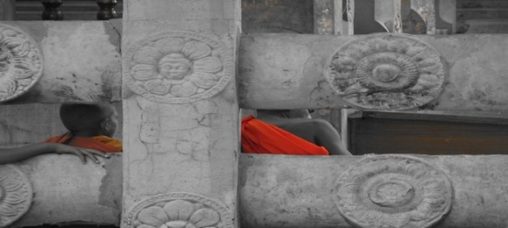
Buddhist monks from a variety of nations make the pilgrimage to the Mahabodhi Temple to meditate under the Bodhi tree. It’s a peaceful respite from the chaos of India’s urban areas.
Bhikkhuni (Buddhist Nuns) © Gennaro Salamone
All Buddhist traditions have Bhikkhuni (Buddhist Nuns). While nuns take the same important vows, their position and stature within the Buddhist community is largely determined by their country.
The Bodhi Tree, Mahabodhi Temple © Gennaro Salamone
The Bodhi tree at Mahabodhi Temple is an ancestor of the original tree that Siddhartha Guatama attained enlightenment under around 530 BCE. Visitors and monks alike wait for falling Bodhi leaves which symbolize good fortune.

Prayer Flags, Mahabodhi Temple © Gennaro Salamone
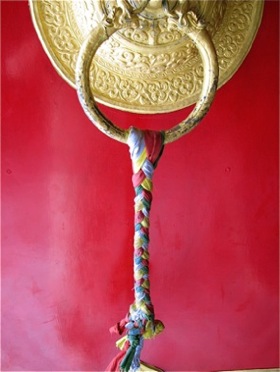
Buddhist Emperor Asoka is considered the founder of the Mahabodhi Temple. It’s a brilliant architectural structure. The central tower rises to over 180 feet (55 meters). Lucky prayer flags are seen throughout the complex.
Buddha Statue © Gennaro Salamone
Bodh Gaya, India is home to thousands of Buddha statues of various sizes. Each statue has a unique meaning in connection with the Buddha’s positioning and facial expression.
Buddhist Monk Chanting © Gennaro Salamone
Buddhist chanting takes place regularly under the Bodhi tree. Pilgrims and tourists alike take in the beautiful rhythms of the chants. Many visitors and monks begin to pray at this moment.
Read about three perfect places to meet Buddhist monks then follow another photographic journey to Cusco, Peru or Angkor Wat, Cambodia.
___________________________________________________________________________________
Gennaro Salamone is the founder and editor of Enduring Wanderlust. Feel free to contact him with questions, comments, or inquiries with reference to contributing a travel article or photograph for publication.
Sign up to receive our free content RSS or travel updates by e-mail.
Recycled Masterpiece: Chandigarh’s Rock Garden
January 9, 2009 by Gennaro
Filed under Destinations, Featured, Green
Chandigarh, India is a pleasant surprise to travelers who have braved the chaos of the country’s rickshaw-filled roads. The streets of this urban center are well-ordered with sculptures and trees throughout. The jewel of Chandigarh is Nek Chand’s Rock Garden (Map). The garden is comprised of recycled materials including ceramic pots, glass bottles, sinks, and broken plates. It is a place of inspiration for those who support a movement toward green living.
Rock Garden, Chandigarh © Gennaro Salamone
For those making the journey, the garden has a maze-like path that features a multitude of creative figurines ranging from animals to human forms. You’ll witness tourists and locals alike marveling at the modern wonder that was developed by Chand. On most days, locals are seen picnicking or sharing a romantic moment on the grounds (see below). To have a particularly unique experience, ask the information desk if Mr. Chand is at the garden during your visit. If so, he’ll be more than happy to visit with travelers.
Couple, Chandigarh, India © Gennaro Salamone
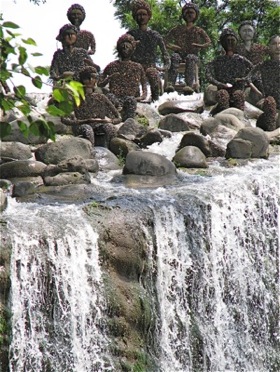
Toward the end of your walk, a lovely waterfall will appear with human figures atop it. This is a comfortable spot to relax for a few moments in shaded areas. Upon leaving the complex, it’s a short cycle rickshaw ride to the Open Hand Monument, which remains the official logo of the city.
Waterfall, Chandigarh, India © Gennaro Salamone
After returning to the city-center, consider having dinner at Ghazal Restaurant (Map). Ghazal has excellent service along with classic Indian dishes. For window-seating and extra attention from the staff arrive 15-20 minutes before traditional dinner is served.
If you’re unsure about making the trip to Chandigarh consider combining it with a journey to the hill station of Shimla. Kalka, the town where the toy train to Shimla originates, is only an hour from Chandigarh.
Read about Bodh Gaya, India.
___________________________________________________________________________________
Gennaro Salamone is the founder and editor of Enduring Wanderlust. Feel free to contact him with questions, comments, or inquiries with reference to contributing a travel article or photograph for publication.
Subscribe to the Enduring Wanderlust RSS or subscribe by e-mail to receive daily travel updates directly to your inbox.
Indian Gov’t To Travel Writers: Prove We’re Safe
December 28, 2008 by Gennaro
Filed under Travel News
The Indian government has invited top travel writers to visit local tourist locations, including the sites of the recent terrorist attacks, to witness the measures taken to provide safety for tourists.
The attacks against tourist hotels in Mumbai have taken a toll on Indian tourism. India has been plagued by terrorist bombing over the past few years, but the international attention focused on the most recent assault will likely pose a greater challenge for Indian tourism.
During the summer, editors from Enduring Wanderlust witnessed increased safety measures in Delhi. This security was mainly around the city’s train stations and the business district. Though these steps were welcomed, it was clear that more was needed to protect residents and travelers. Several of the metal detectors weren’t working properly and few bags were manually checked by attendants. With the recent attacks, it’s vital that the travel writers who visit India provide a detailed report on the new measures taken by the government.
Taj Mahal, India © Gennaro Salamone
Read about the recycled rock garden of Chandigarh, India or about the increase in women traveling solo and its safety ramifications.
___________________________________________________________________________________
Gennaro Salamone is the founder and editor of Enduring Wanderlust. Feel free to contact him with questions, comments, or inquiries with reference to contributing a travel article or photograph for publication.
Subscribe to the Enduring Wanderlust RSS or subscribe by e-mail to receive daily travel updates directly to your inbox.
3 Perfect Places To Befriend A Buddhist Monk
December 27, 2008 by Gennaro
Filed under Featured, Spiritual, Travel Tips
1. Luang Prabang, Laos
Luang Prabang is an enchanting town in Southeast Asia. It has numerous Buddhist Temples (Wats) that are filled with novices and monks practicing their faith. For the traveler, Luang Prabang provides an unmatched opportunity to converse with the novices (individuals who are studying in preparation for full ordination) of the temples. Each day novices study a variety of subjects including language courses. English has become increasingly popular among novices who will either become fully ordained monks or return to Lao society.
The easiest way to build a conversation with novices or monks is to spend a significant amount of time on the grounds of one of the many temples. In most cases you can approach one of its residence and ask a few questions about Buddhism to open a dialogue. After a few minutes, you will be immersed in a discussion about a variety of topics ranging from faith to your homeland.
Luang Prabang has seen a significant growth in tourism over the past few years. Be thoughtful in your approach with the temples and its residence. Remember that this is their place of worship and their home.
Luang Prabang, Laos © Gennaro Salamone
2. Mahabodhi Temple of Bodh Gaya, India
Bodh Gaya, India is where Siddhartha Guatama attained enlightenment. There are few places on earth that match the peacefulness of its Mahabodhi Temple, which was built at the Bodhi tree where the Buddha sat under around 530 BCE. Visitors to hectic India will be particularly relaxed sitting among countless Buddhist monks who make journeys to India to pay respect to the Buddha and to collect falling leaves from the famous Bodhi tree.
If you’re lucky, you may be meditating next to the singing Thai monk who visits the temple regularly. He happens to have an affinity for tying Western music to Buddhist philosophy. You will likely hear: “keep smilin’, keep shinin’.” Knowin’ you can always count of me, for sure” or “let it be, let it be. Whisper words of wisdom, let it be.” The great philosopher will also help you deal with India’s stifling heat with his little bottle of Thai Ang Ki, which cools your skin when added to a sprinkling of water.
Mahabodhi Temple © Gennaro Salamone
3. Vang Vieng, Laos
If you can remove yourself from the crowds of young backpackers who are rock climbing, tubing down the river, and watching Friends re-runs in the restaurants of the city, Vang Vieng offers an opportunity to learn a lot about the life of Buddhist monks. You can wake up at the crack of dawn to donate food stuffs to the lines of novices along the main street of the town collecting for their temples’ lunch. Later, it’s possible to attend prayer sessions at the local wats. At one temple, the monks invited us to partake in the prayer ritual along with subtle lessons in etiquette.
There were fewer novices and monks who spoke English than at Luang Prabang, but an equal number of smiling faces ready to greet travelers who are interesting in Lao culture or Buddhist teaching. If you’re seeking detailed explanations about Buddhism consider asking for the monk, at the main residency, who teaches English to novices.
Read about rock climbing in Laos or the six steps to a luck Chinese New Year.
___________________________________________________________________________________
Gennaro Salamone is the founder and editor of Enduring Wanderlust. Feel free to contact him with questions, comments, or inquiries with reference to contributing a travel article or photograph for publication.
Subscribe to the Enduring Wanderlust RSS or subscribe by e-mail to receive daily travel updates directly to your inbox.