A Poconos Weekend Getaway

February 1, 2011 by  
Filed under Destinations, Features

The Poconos Mountains is a popular recreational destination located in northeastern Pennsylvania. It is especially well-liked among local and regional visitors as it is within a couple of hours of several high population centers. Tourists arrive for a variety of reasons including camping, gambling, skiing, and romantic getaways. This particular trip involved a short drive from New York City and a stay at a couples resort called Paradise Stream Resort, which is one of three couples resorts under the Cove Haven Resorts umbrella.
lake-poconos Lakeside Accommodations @ Paradise Stream Resort © Gennaro Salamone

Paradise Stream is considered the most modern of the three couples getaways — each of which has similar theme-based rooms, outdoor activities, and on premises activities for two. During our stay, activities ranged from ice carving and wine pairing to carriage rides and outdoor photography. We also took a fun paddleboat ride on the lake above with its playful ducks diving for food. Though the activities are plentiful including all-inclusive nightly entertainment like comedian Brad Garrett of Everybody Loves Raymond fame, the rooms are likely the main draw for couples.
heart-pool champagne-tower Heated heart-shaped pool + 7-foot champagne glass whirlpool © Gennaro Salamone

The resort rooms come in all shapes and sizes, but The Champagne Tower lodging is the most interesting. Walking through the hotel door reveals a 7-foot champagne glass whirlpool next to a fireplace. Not something you experience often. With that, the heated heart-shaped pool may have been even more enjoyable with its attached sauna.

Even with all the different activities that are available at the resorts — it’s easy to let the weekend pass by mostly relaxing in the comforts of the accommodations. Be it breakfast in bed wearing bathrobes or champagne and strawberries in front of the burning fireplace, Paradise Stream is for couples looking for a fun and stress-free few days. If you’re looking to visit one of the Cove Haven Resorts, February is their Month of Love featuring special packages.

This stay at Paradise Stream Resort was courtesy of the Coven Haven Resorts. The content and opinions in the article are those of the author.

___________________________________________________________________________________
gennaro-salamone-photo.jpgGennaro Salamone is the founder and editor of Enduring Wanderlust. Feel free to contact him with questions, comments, or inquiries with reference to contributing an article or photograph for publication.


Receive our free content by e-mail directly to your inbox or through an RSS reader.

The Bavarian Maibaum Festival

November 4, 2010 by  
Filed under Features, Photography

The Maibaum or Maypole festival is a typical Bavarian cultural event. It has been taking place in towns throughout Germany and Austria since the 16th century. Follow the traditions of this Bavarian celebration through the lens of photographer Rolf Hicker.

It takes many strong men to lift the traditional maibaum (decorated tree) at the festival, which is mostly organized by local traditional youth groups. The maibaum itself gets erected by a group of helpers because the tall tree is lifted with only a selection of smaller poles. The process can take many hours. During the last push to get the tree up, you’ll hear the men screaming “hau rucks” for leverage and unity.
Traditional Maibaumfest in Putzbrunn in Southern Bavaria, Germany, near Munich. Traditional Maibaumfest in Putzbrunn in Southern Bavaria, Germany, near Munich. Lifting of the Maibaum © Rolf Hicker

At the event, visitors can find many of these participants wearing traditional Bavarian clothing. Special socks are part of the traditional Bavarian clothing that’s worn during the lifting process. These special socks are worn with the famous German “lederhosen.”
Traditional Maibaumfest in Putzbrunn in Southern Bavaria, Germany, near Munich. Traditional Maibaumfest in Putzbrunn in Southern Bavaria, Germany, near Munich. German men wearing lederhosen © Rolf Hicker

While the boys are lifting up the maibaum, the girls are making sure that the guys are staying hydrated with original Bavarian beer. These women are wearing traditional clothing called a dirndl during the festivities. The traditional maibaum fest is a all day event. It’s common to see young men filling up a Masskrug or a 1 Liter Stein with fresh beer from a large wooden barrel.
Traditional Maibaumfest in Putzbrunn in Southern Bavaria, Germany, near Munich. Traditional Maibaumfest in Putzbrunn in Southern Bavaria, Germany, near Munich. Woman wearing a dirndl + Man with Bavarian beer © Rolf Hicker

 
___________________________________________________________________________________
rolf-hicker.jpgRolf Hicker is a full time pro photographer who specializes in travel, nature, and wildlife. His images have been published in many of the largest magazines including National Geographic and Readers Digest as well as with some of the best known brand names like BMW, Holland America, Porsche, and Alaska Airlines. View more of Rolf’s Germany Pictures.


Receive our free content by e-mail directly to your inbox or through an RSS reader.

How to Make Homemade Wine

October 26, 2010 by  
Filed under Destinations, Features, Food

The winemaking process is uncomplicated, but it requires several steps and a lot of patience. Together with that, making homemade wine requires a few days of labor and months of fermentation in order for the wine to be ready for consumption. While there are slight variations to the process, this is a time-tested method that was learned through my father. It comes from a long tradition of Italian winemakers from a small mountain town in Italy. That knowledge was later brought to the United States.

Step-by-Step Process: How to Make Homemade Wine

Step One: Gathering the Equipment

Purchasing the right equipment is the first step to making homemade wine. It requires:

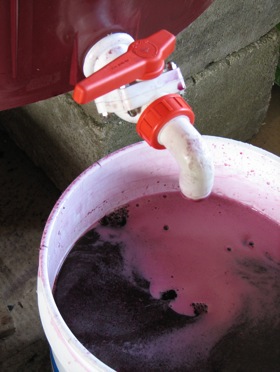
An initial fermentation container that is big enough to hold your crushed grapes. It needs to be a high quality plastic container. Modern versions have a drainage nozzle, which makes it easier to transfer the wine juice to the long-term fermentation jugs.

Long-term fermentation containers (carboys or demijohns) that can be glass jugs or oak barrels. The former tends to be more consistent year-to-year. Depending on your batch of wine the sizes can range from 1 to 15 gallons.
grape-crusher-wine ratchet-basket-grape-press Grape Crusher + Ratchet Basket Grape Press © Gennaro Salamone

Plastic tubing that’s at least 6 feet long is required for transferring the juice between containers.

A manual or motorized grape crusher (de-stemmer optional) is needed for squashing the grapes.

A ratchet basket grape press and pressure discs are necessary to squeeze the remaining juice from the grapes in the primary fermentation container.

While some add yeast or tablets, this process doesn’t use additives.

Plastic buckets are required to capture wine from the press and to move the grapes from the initial fermentation container to the press.

A funnel with a strainer is needed to transfer grape juice from the buckets to the demijohns.

Enough cases of grapes to meet your needs are also necessary.

Step Two: Preparing the Equipment

Prepare a large space that will fit your initial fermentation containers, a basket grape press, and the cases of grapes. You will also need an electrical outlet if using a motorized grape crusher. Be sure to wash all of your equipment and to open the cases of grapes and inspect to make sure that the fruit is healthy and ready to be crushed.

Step Three: Crushing the Grapes and Initial Fermentation Container

Place the manual or motorized grape crusher over the initial fermentation container, which is at least a foot off the ground. One person will be ensuring that the machine is in place and another will be responsible for dumping the cases of grapes into the crusher. Fill the container and leave at least a foot of space at the top. The grapes will stay in this container for about a week. Be sure to use a cover. A sheet or similar will do. Be sure to use a closed space.
home-wine-making homemade-wine Homemade wine © Gennaro Salamone

Step Four: Secondary Fermentation and Transfer to the Secondary Containers

Transfer the wine juice to the secondary fermentation container. If you’re using a modern high quality plastic container for the initial fermentation then simply place a bucket under the drainage nozzle. If not, use a plastic tube from the grape-filled container to the buckets. Place the funnel with the strainer into the demijohn and pour the buckets of grape juice into it. Do not fill them up. An airlock will be need for the secondary container for extended fermentation. Start with paper towels for a day or so then use an actual airlock device. The wine juice will remain in these jugs for at least 4-6 months. It’s best to store it in a cool and dark place.

Step Five: Bottling and Drinking

Once the fermentation process has been completed, you are free to bottle the wine. Rack or siphon off the sediments from the wine using a plastic tube while transferring it to the bottles. Cap tightly. At this point, the vinification process has been completed and it’s ready to drink.

___________________________________________________________________________________
gennaro-salamone-photo.jpgGennaro Salamone is the founder and editor of Enduring Wanderlust. Feel free to contact him with questions, comments, or inquiries with reference to contributing an article or photograph for publication.


Receive our free content by e-mail directly to your inbox or through an RSS reader.

A Scenic View of New York City

October 19, 2010 by  
Filed under Features, Photography

New York City has a captivating urban landscape. Follow this photographic journey through the lens of local New York photographer, James Maher.

This is a time-lapse exposure of a busy city crowd moving through Grand Central Station.  The effect was created completely in-camera. The woman seemed to be a lonely tourist waiting for someone to come rescue her.  She was so amazingly still that she looked afraid to even move. I never saw anyone come, and she soon walked off by herself. 
grand-central-terminal Waiting in Grand Central Station, New York City © James Maher

This is a photo that I’ve been wanting to take for a long time. It captures two New York City subway trains in motion. This image was also created completely in-camera at the 72nd Street station in 2010.
train-new-york-subway Subway Trains in Motion, 72nd Street, New York City © James Maher

This photo was taken from the top of my mother’s building on Broadway and 94th street on a hot summer night in June of 2007. Lightning was flashing all around the building and the wind was gusting hard. Soon after this photo, it started to pour and the lightning strikes got close enough that I thought it best to leave. Earlier in the day, it is believed that one of these strikes hit a substation in Queens and was the cause of a blackout in the Bronx and on the Upper East Side, which created a lot of chaos during the 90 degree weather.
new-york-weather-lighting Lightning over Manhattan, New York City © James Maher

This photo was taken during the huge blizzard that hit the city in 2003. The snowstorm created such bad conditions that for much of the day I was completely lost in the park. At some point I found this bridge to seek refuge under. It didn’t take long before this couple came along with the same idea.
central-park-winter-tunnel Couple in Snowstorm, Central Park, New York City © James Maher

The Chrysler Building, in my opinion, is the most iconic building in the city. The Gargoyles are probably the most talked about aspect of this classic Art Deco building, but I much prefer the metal spire, which can often be seen glinting like a diamond in the hot sun, or glowing throughout the night.
chrysler-building-black-and-white Chrysler Building Spire, New York City © James Maher

 
___________________________________________________________________________________
james-maher.jpg James Maher is a fine art street and studio photographer based in New York City.  James credits his inspiration for photography to his love for the city and its endless supply of personalities to capture and streets to explore.  His New York photography consists of both scenic and architectural views of the city, as well as the closeup daily life of the people on the streets.
 

Receive our free content by e-mail directly to your inbox or through an RSS reader.

Riding an Elephant in Thailand

October 7, 2010 by  
Filed under Destinations, Features

Chiang Mai, Thailand is the answer. Where to ride an elephant, how to ride an elephant, and where to hug and kiss a baby elephant are the musings. The voyage began with a serene 8-mile bike ride from the rustic Lisu Lodge to the elephant camp. Despite the excitement surrounding the elephant riding, the natural beauty of the Chiang Mai countryside still manages to capture your attention.

On arrival, several gentle giants standing near the river met our group of travel writers. Among the elephants was a pregnant female who managed to carry two of us along the mountainous jungle scenery down the river. The secret to riding this particular elephant was to ensure that she was fed plenty of bananas. Be sure to put aside enough bananas for the entire trip, as her trunk will be jumping back to collect a reward every few steps.
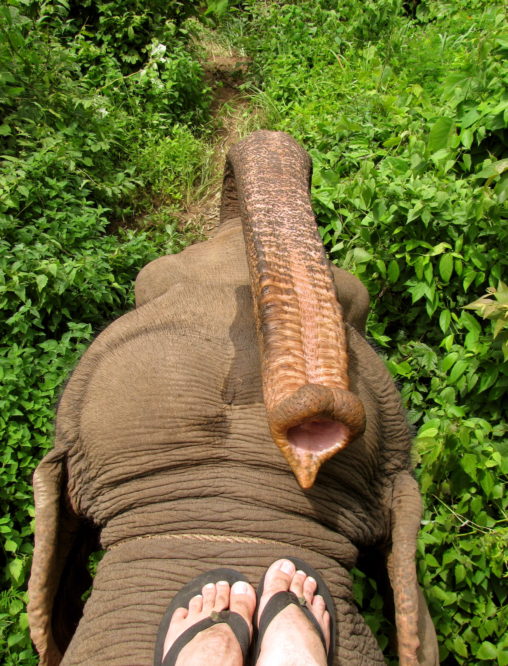
riding-elephants-thailand angela-dollar-feeding-elephants Elephant reaching for Gennaro’s feet + Angela Dollar feeding an elephant © Gennaro Salamone

Behind the pregnant giant was a 3-year old baby elephant that followed along for the journey sans passenger. He spent most of the trip using his trunk to throw dirt over his shoulder ensuring protection against the sun and insects. While the ride along the river was wonderful, the highlight of the day was bonding with the baby elephant at the end. I walked over to the receptive animal and proceeded to hug and kiss him. It’s not every day that you can connect with one of the largest land mammals.
gennaro-salamone-hugging-elephants kissing-baby-elephant Hugging and kissing a baby elephant © Gennaro Salamone

There are several options that allow for a similar experience. Elephant Nature Park is one of the better choices with over thirty rescued elephants from infants to old-timers. They have everything from day trips to three-week long volunteer stays.

This trip to Thailand was courtesy of the Tourism Authority of Thailand. The content and opinions in the article are those of the author.

 
___________________________________________________________________________________
gennaro-salamone-photo.jpgGennaro Salamone is the founder and editor of Enduring Wanderlust. Feel free to contact him with questions, comments, or inquiries with reference to contributing an article or photograph for publication.


Receive our free content by e-mail directly to your inbox or through an RSS reader.

Rice Farmers of Thailand Through the Lens

September 14, 2010 by  
Filed under Features, Photography

Chiang Mai is the largest city in northern Thailand. A combination of natural beauty and countless cultural activities makes the area a popular tourist stop. Travelers have the opportunity to visit local hill tribes, sample delectable local cuisine, and raft along the Ping River. On this day, a local guide led our small group of travel writers on a tour of Lanna or the “land of a million rice fields.”

Follow this photographic journey featuring the Akha hill tribe transplanting rice:

khum-lanna rice-paddies-thailand Khum Lanna + Chiang Mai Rice Paddies © Gennaro Salamone

We were set for a sunrise biking tour along the rural country road from San Kwang village to Phrao to visit the local markets. Leaving the charming Khum Lanna, we were met by steady rains that prevented a view of the sunrise. Despite that, the early showers on the emerald-green rice paddies provided a tranquil atmosphere for the sojourn.

traditional-thai-people thai-women-working Akha Hill Tribe Transplanting Rice © Gennaro Salamone

We visited the local markets, stopping for tea and an interesting traditional drink that consisted mainly of raw eggs, before heading off to the area of the rice paddies where the Akha tribe was transplanting rice. Working in the rice paddies appeared to be labor intensive, but smiles were common among the inhabitants. This work is essential to the economic success of Thailand, which is the world’s biggest rice exporter according to the Bangkok Post.

thai-man gennaro-salamone-rice Local Farmer © Gennaro Salamone + Overzealous Travel Writer (Taken by Ted Beatie)

The highlight of the morning was an opportunity to join the Akha in the rice paddies for some hands-on learning. It’s one thing to observe the nature of the labor, but having your legs ankle deep in mud while bending to stick rice plants into the ground gives a new level of understanding. We were fortunate to have a guide who had relationships with the community. Sometimes, it’s worthwhile to forgo complete independence while traveling.

I was joined on the trip by travel writers: Angela Dollar, Ted Beatie, and Carlo Alcos. Visit and bookmark their websites. After that, view Lake Titicaca photos featuring the Uros people.

This trip to Thailand was courtesy of the Tourism Authority of Thailand. The content and opinions in the article are those of the author.

 
___________________________________________________________________________________
gennaro-salamone-photo.jpgGennaro Salamone is the founder and editor of Enduring Wanderlust. Feel free to contact him with questions, comments, or inquiries with reference to contributing an article or photograph for publication.


Receive our free content by e-mail directly to your inbox or through an RSS reader.

The San Gennaro Festival

September 13, 2010 by  
Filed under Features, Photography

The Feast of San Gennaro is the longest running festival in New York City. It began in 1926 with the arrival of immigrants from Naples, Italy who lived along Mulberry Street in Little Italy. Revered by Neapolitans, as their protector, legend has it that vials San Gennaro’s blood liquify several times per year including on September 19. Though the festival still maintains religious significance to many attendees, it is primarily a celebration of the Italian culture that once filled the streets of the community.

little-italy-new-york-city little-italy-restaurant Little Italy, New York City © Gennaro Salamone

What was once a thriving Italian enclave, Manhattan’s Little Italy has shrunk over the decades leaving only a small section with Italian restaurants and shops. While visiting Arthur Avenue in the Bronx provides for a more authentic experience, attending the San Gennaro Festival is an opportunity to participate in a traditional street fair.

torrone-san-gennarozeppole-san-gennaro Torrone + Zeppole © Gennaro Salamone

The highlight for festival goers is eating Italian food from street vendors. Sausage and peppers, zeppole, and cuts from giant slabs of torrone are especially popular. There is also a cannoli-eating contest for those with bottomless stomachs.

italian-americans feast-of-san-gennaro Italian Americans cooking traditional sausage © Gennaro Salamone

When they’re not preparing your meal, vendors exhibit their fun-loving and uninhibited nature. It’s a much needed diversion from the crowded lines on Mulberry and the adjacent streets.

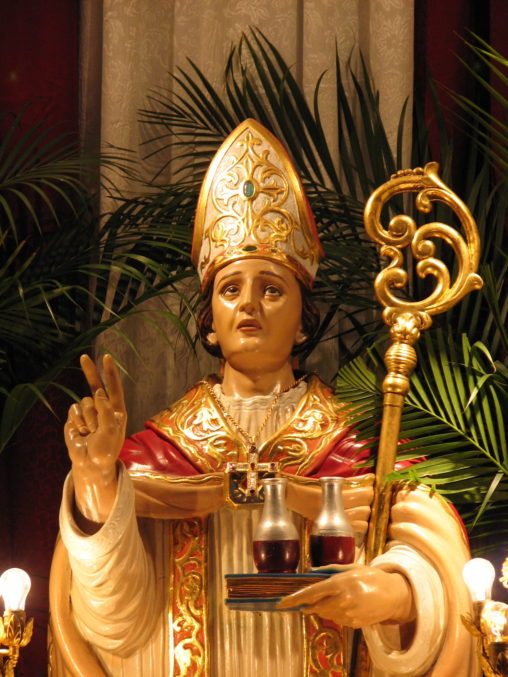
italian-horn-corno san-gennaro-statue Italian horns (corni) protect against the evil eye + Pinning of money on San Gennaro © Gennaro Salamone

For individuals who are more interested in the religious aspects of the San Gennaro, a mass is held on the official Saint Day (September 19) at the Most Precious Blood Church followed by a procession. It is tradition to pin money on the statue of San Gennaro as a donation to the church.

 
___________________________________________________________________________________
gennaro-salamone-photo.jpgGennaro Salamone is the founder and editor of Enduring Wanderlust. Feel free to contact him with questions, comments, or inquiries with reference to contributing an article or photograph for publication.


Receive our free content by e-mail directly to your inbox or through an RSS reader.

The Best NFL Stadiums to Visit

April 23, 2010 by  
Filed under Destinations, Features

While Major League Baseball is considered the national pastime in the United States, NFL football has surpassed baseball in overall popularity over the last decade. It has become a Sunday tradition for sports fans who either watch on television or attend games, which consists of hours of tailgating followed by heart-pounding action. For the best experience, visit one of these stadiums:

Lambeau Field (Green Bay Packers)

Lambeau Field is the home of the Green Bay Packers. The oldest stadium in the league has the best atmosphere for football including a stadium filled with passionate fans, often wearing cheesehead hats, who endure frigid temperatures to watch their beloved Packers. Together with an unmatched game environment, Lambeau’s Frozen Tundra has been home to three Super Bowl championship teams starting with the first two titles under coach Vince Lombardi and ending with the Super Bowl XXXI title largely won on the arm of popular quarterback Brett Favre.
lambeau-field.jpg Lambeau Field © Karen54301

Cowboys Stadium (Dallas Cowboys)

Opened in 2009, the new Cowboys Stadium is a state-of-the-art facility with the largest high definition video screen in the world. That along with an impressive franchise history including appearances in a record 8 Super Bowls makes a trip to Arlington, Texas a must for any football fan. Dubbed America’s Team after a run of success in the 1970’s, the Cowboys currently have a brash owner who helped usher in 3 titles in the 1990’s lead by Hall of Famers Troy Aikman, Michael Irvin, and Emmitt Smith. In addition to NFL football, Cowboys Stadium hosted a record 108,713 fans for the 2010 NBA basketball All-Star Game in an effort that was spearheaded by Dallas Mavericks owner Mark Cuban and Cowboys owner Jerry Jones.

Heinz Field (Pittsburgh Steelers)

Heinz Field is the home of the Pittsburgh Steelers. Dubbed Steeler Nation, fans of this record 6-time Super Bowl championship team fill the stadium with black and gold. This passionate group of fans is also known for following and supporting the team on road games. As with the Cowboys, the Steelers built their massive fan base during their 1970’s championship run lead by quarterback Terry Bradshaw, running-back Franco Harris, and coach Chuck Noll’s “Steel Curtain” defense. The Steelers have also won Super Bowls in 2005 and 2008 with recently troubled quarterback Ben Roethlisberger leading the way.

Arrowhead Stadium (Kansas City Chiefs)

Visitors to Arrowhead Stadium will experience The Sea of Red, which is the nickname given to the loudest fans in the NFL. Though the Seattle Seahawks fans (The 12th Man) at Qwest Field would disagree since that is likely the loudest stadium in the NFL. Despite years of a home field advantage because of the high decibel level in the building, the Kansas City Chiefs have struggled over the last few years and haven’t reached a Super Bowl since the 1960’s under quarterback Len Dawson. That being said, it’s worth a trip to experience the hours of tailgating before the game along with a rarely matched fan atmosphere. Be sure to wear red and bring a pair of earplugs.
tailgating.jpg Tailgating in Cleveland © Nolosabias

Lucas Oil Field (Indianapolis Colts)

Lucas Oil Field is the home of the Indianapolis Colts. Despite the aesthetically pleasing design of the stadium, the main draw is an excellent fan atmosphere along with a consistently dominant team led by record-breaking quarterback Peyton Manning. The Colts have finished first in the AFC South for 7 straight seasons. This has led to a Super Bowl win in 2006 and a loss in 2009 to quarterback Drew Brees and the New Orleans Saints. Though Indianapolis may be a bit off the beaten track for travelers, it also has one of the best basketball venues (read the list) called Conseco Fieldhouse.

Meadowlands Stadium (New York Giants and New York Jets)

2010 welcomes the unveiling of the new Meadowlands Stadium, which is the home of the New York Giants and New York Jets. With 82,500 seats, it’s second only to the Redskins FedEx Field in overall capacity. Big Blue has been more successful over the years in terms of Super Bowls wins including wins in 1986 and 1990 led by Coach Bill Parcells and a tough G-Men defense with Lawrence Taylor and Carl Banks. The Giants led by Eli Manning also upset the New England Patriots in Super Bowl XLII ruining their chance at an undefeated season. The Jets, on the other hand, won the most important Super Bowl in NFL history in 1968. The upset of the Colts in Super Bowl III led by Broadway Joe Namath solidified the AFL-NFL merger. A benefit of selecting a Jets game over a Giants game would be a chance to hear the loud chants of J-E-T-S led by Fireman Ed. The new stadium ensure that Giants games will be filled with a sea of blue while Jets games will be transformed to a haven for green.

Read about the best MLB ballparks and the best NBA arenas.

 
___________________________________________________________________________________
gennaroeditor.jpgGennaro Salamone is the founder and editor of Enduring Wanderlust. Feel free to contact him with questions, comments, or inquiries with reference to contributing an article or photograph for publication.


Receive our free content by e-mail directly to your inbox or through an RSS reader.

Uganda: Next Kenya or Tanzania?

March 31, 2010 by  
Filed under Destinations, Features

When you hear Uganda, if you’ve never been there, the first thing that comes to mind is Idi Amin and perhaps the more recent civil unrest in the north. Well, I certainly associated Uganda with these things, but when I visited the country last month, it painted a different story altogether. Now, when I think about Uganda, I think of lush green hills, white water rafting (apparently, the second best rapids in the world), gorilla safaris, which I wished I’d done, and the very friendly people.

Editor’s Note: This post was written by guest contributor Meera Ashish.

So, discovering how much Uganda has to offer, why then is Uganda not a tourist hot spot? Well, I definitely met tourists while traveling around here, but why isn’t Uganda on the tourist map as much as say Kenya or Tanzania? Of course, the quality of safaris that the latter two countries offer are unrivalled, but if you go to the right places in Uganda, you’ll certainly get to see the big five. When I visited Murchison Falls, I managed to see two lionesses and one majestic lion from up close on my very first day. When I say close, they were just steps away from our jeep: sitting, lazing, and yawning. One thing’s for sure, traveling by road to Murchison Falls or anywhere can be a little tiring, though simultaneously eye-opening, and if you want to take a plane anywhere, it might pinch your pockets. So it definitely doesn’t help that traveling within the country is either long or expensive.
sipi-falls-uganda.jpg kampala-sunset Sipi Falls + Kampala Sunset © Meera Ashish

But regardless of all this, I think the lack of tourism here is to do with the fact that there just hasn’t been enough of a push in media. Yes, Uganda may have its own problems, just like any other country, but it seems that the government here needs dedicate a team and invest some capital into marketing the country. No matter how much a country has to offer, if the average person living in any other city of the world doesn’t hear anything about it – well apart from watching Last King of Scotland and thinking that Uganda still hasn’t quite recovered from the despotic leader it had so many years ago – then how can that country expect to attract high numbers of tourists?

And it isn’t just the game parks, the gorillas and the Nile that can attract tourists. Kampala, the capital city of Uganda, is bustling with activity. It was a good place to start from, but also fascinating to understand the growth potential here, learning that Uganda had found barrels and barrels of oil. I wondered how different it would look in ten years, with all the oil money.

cycle-4-uganda.jpg Biking in Uganda © Meera Ashish

Apparently, they say that the land in Uganda is so fertile that anything you put in the soil will grow and bloom. Well, all the food I ate here certainly tasted extremely fresh and organic. The staple food here –a stodgy and mushy matoke mixed with groundnut soup and then a bean mixture (not quite sure what to call it) – might look bland and a little grubby, but it tastes pretty good. And some of the best dishes, you’ll find being cooked on the streets, from fresh and hot cassava to something called rolex – a rolled up fluffy egg chapati. I had this – without the egg – while quad biking through a village in Jinja. Nothing could have tasted better!

The quad biking route in fact overlooks the rafting in the Nile, but having never done rafting, I was a little apprehensive this time. Which means I have a lot left for next time. And the great thing is: I’m coming back at the end of this year for a bike ride from the famous Sipi Falls to Kampala, raising money for secondary schools in Uganda. Cycle4Uganda is hoping to attract a hundred people from around the world to participate in this 350km bike ride over the New Year period.

uganda-girls.jpg Girls from Uganda © Meera Ashish

The route will take in some of the most scenic spots in the region. Beginning at the imposing Tororo Rock, an ancient volcanic plug, the route takes us into the foothills of the magnificent extinct volcano, Mount Elgon, to view the spectacular Sipi Falls, a series of waterfalls with imposingly huge drops where much of the water from the mountain cascades off. Halfway through the ride there is an action packed ‘day-off’ in Jinja – so I’ll be rafting then. The route finishes with us leaving our bikes on the lakeshore and taking a small boat across Lake Victoria to a resort in Kampala, the capital city. We’ll be passing not only through the rural country, but also through several bustling towns. And of course, it’s going to be warm (apparently a warm climate all year round as it sits on the equator).

The bike ride is aiming to raise £150,000 or $230,000 to help secondary schools in Uganda. This will be done through an innovative program that has been devised by Mara Foundation, a charity based in Uganda. Rather than just spending money on a school and then going away, Mara Foundation partners with schools long-term to help them come up with new solutions for providing better education. The charity is quite unique – it recognizes the importance of good facilities, so raises money to develop them, but it also acknowledges that good facilities is only a small part of a quality education. The foundation has already partnered with two schools and hopes to scale the program up to ten schools in the coming year.

If you want to join the bike ride over the coming New Year, sign up on Cycle4Uganda.

 
___________________________________________________________________________________
meera-ashish.jpgMeera Ashish is a weekly travel columnist for Gulf News, Dubai and contributes to various publications including Bazaar, Conde Nast, Spa Secrets, Epoch Times, and Travel Plus. Her guide to Dubai was recently published in the UK, and while she was born and brought up in London, she now splits her time between Uganda and Dubai – well, that’s when she’s not journeying around the world.


Receive our free content by e-mail directly to your inbox or through an RSS reader.

5 Arts Festivals That You Can’t Miss

February 17, 2010 by  
Filed under Features

Editor’s Note: This post was written by guest contributor Andy Hayes.

You don’t have to be a lover of the theatre or a liberal arts junkie to enjoy a good arts festival. In fact, some festivals are destinations in themselves – cities double in size and locales morph into totally new personalities. Check out the places and dates for these arts festivals that you just can’t miss – then add one into your upcoming travel plans.

Edinburgh Fringe (August)

The Edinburgh Fringe is just one of several festivals that take place in Scotland’s capital city in August. Edinburgh swells in capacity as performers and audiences from around the world arrive to enjoy the party atmosphere and crazed vibe of the world’s largest arts festival. The Fringe originally started with heavy themes of sex and nudity, and in fact you’ll still find a racy scene or two today. Comedy is a huge focus but there’s also offbeat musicals and visual theatre. Book early for this one – and be prepared for non-stop action, including late night comedy and all night clubbing.
edinburgh-fringe-art-festival.jpg Edinburgh Fringe © Matito

World Buskers Festival (January)

Who would have thought a sleepy English town on New Zealand’s south island would have a can’t miss festival? You bet: The World Buskers Festival takes place here every January, and if you like the soothing sounds of a random subway musician or street corner comedian, then you have to see this. Everywhere you turn someone has managed to pull together a crowd to watch their act. It’s nice to see a lot of the country’s home grown talent showing off their skills, but plenty of international artists you might not have heard of will leave you with a lasting impression – and a sore stomach from all the laughter.

Echigo-Tsumari (August-September)

So, so sorry. You’ve already missed the inauguration of the world’s largest outdoor art festival. This festival was so big that you could spend the night there – two of the artworks were turned into hotels for the exhibition. Between the 350+ works, you’ll find trees with eyes, fields with gorgeous views and abstract pieces, weird and wonderful houses to explore, and some old schools even that were revamped for the project. Don’t worry, though – word has it that portions of the event will reopen again this autumn, so keep an eye out.
ny-film-festival.jpg New York Film Festival @ Ziegfeld Theatre © Tamaradulva

Wausau’s Artrageous Weekend (September)

It doesn’t have to be big and blazing to be wonderful. How about the free arts celebration in Wausau, Wisconsin, which is approaching its 50th anniversary? It is probably the most family friendly of festivals in our list, with lots of arts-and-crafts fun for the children and adults. It even promotes valuing art from a young age – “young collectors” can purchase their first piece of artwork for less than $25. But of course there are plenty of art displays where you can choose your next centrepiece from well over 100 different artists from all over the United States.

New York Film Festival (September-October)

This one is for all the film buffs and DVD lovers out there. To be honest, I’ve been to Cannes and I’ve been to New York, and if I wanted a film festival backdrop, New York would be it. The Big Apple’s film festival is a two-week blitz of provocative and experimental cinema, particularly their “Views from the Avant Garde” programme which is top notch. New York is one of my favourite places in the world, so after a day of exploring the avenues, you can head out for a film or two before cocktails and dinner. What’s not to like?

 
___________________________________________________________________________________
andy-hayes.jpgAndy Hayes is a professional writer and published author. He’s the editor of Sharing Travel Experiences, an online magazine. Visit their website to find out more. Be sure to follow Andy on Twitter too.


Receive our free content by e-mail directly to your inbox or through an RSS reader.

« Previous PageNext Page »